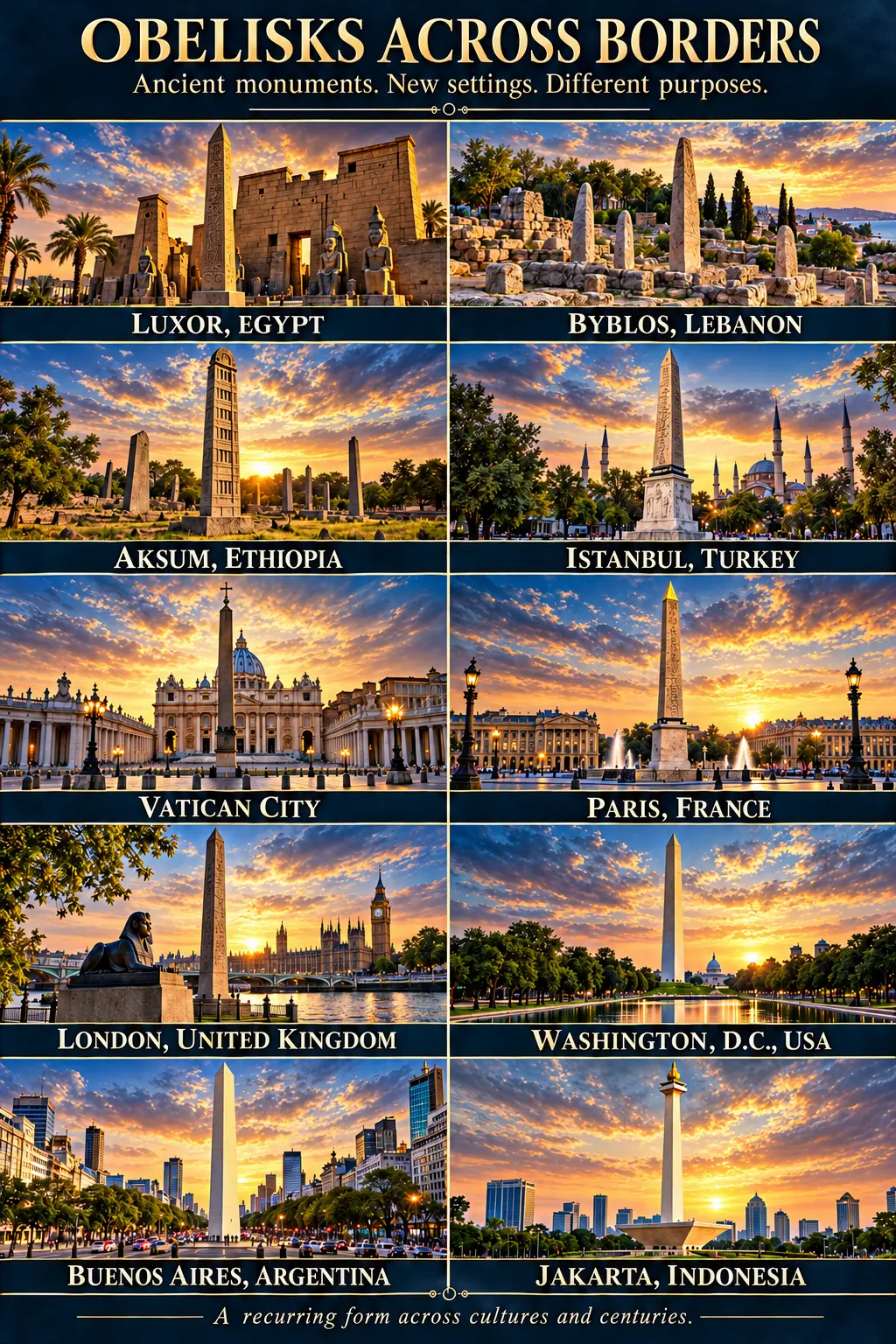
Imagine moving between the worlds we have examined.
Their rulers disagree.
Their languages differ.
Their religious claims compete.
Yet in prominent places, a familiar form rises above the surrounding streets.
Sometimes the stone itself has traveled.
Elsewhere, another people has reproduced its shape.
It stands where crowds gather.
Where authority presents itself.
Where a civilization chooses what deserves to be remembered.
Consider that choice.
People who would reject one another’s gods can still find a place for the same monumental form.
Each can give it an explanation.
A dedication.
A reason to belong.
Almost as though the shape can pass through boundaries that divide those standing beneath it.
Its acceptance does not require agreement about heaven.
Or government.
Or the past.
How does an inheritance become that adaptable?
We have asked whether stories of celestial beings could fragment as peoples separated.
Could a symbol survive by acquiring new meanings?
Could those meanings eventually conceal how far it had traveled?
This time, parts of the journey can be followed through recorded movements and public dedications.
But first, return to the world of the gods.
Watch what stands beside the ruler.
Follow the stone upward.
Four sides.
A narrowing shaft.
A pointed summit.
An obelisk.
Begin in Egypt.
A small scarab preserved in the Metropolitan Museum of Art depicts a pharaoh facing an obelisk.
The museum identifies the scene as the king’s adoration of the sun god.
A ruler.
A monument.
An act of worship.
The object participates in a relationship between kingship and heaven.
Then the trail crosses a border.
Rome.
Egyptian obelisks arrive under imperial authority.
Their weight makes the movement an engineering undertaking.
Their presence makes it a public statement.
The Romans recognize their solar associations and connect them with Sol.
The ancient form enters another civilization.
Its earlier meaning remains useful.
But the journey continues beyond the emperors.
Stand in St. Peter’s Square.
At its center rises an Egyptian obelisk brought to Rome under Caligula.
In 1586, Pope Sixtus V orders its relocation.
Domenico Fontana directs the work.
The stone moves again.
A cross replaces the bronze sphere at its summit.
Pause beneath it.
An Egyptian monument.
Transported by an emperor.
Repositioned by a pope.
Crowned with another sacred sign.
How did it acquire a place within a religious world that rejected the gods associated with its earlier history?
The inscriptions at its base acknowledge the change.
They refer to pagan worship and proclaim purification and dedication to the cross.
The earlier association was recognized.
The new dedication was deliberate.
Its custodians believed its meaning could be changed.
The stone remained.
Now cross the Atlantic.
Washington.
A pale shaft rises above the National Mall.
The Washington Monument.
A newly constructed memorial in the form of an Egyptian obelisk.
The National Park Service identifies that architectural inheritance.
Its purpose is to honor George Washington.
An ancient form has become a national tribute.
Consider the distance between these settings.
Egyptian worship.
Roman imperial display.
A papal dedication.
An American memorial.
The intentions differ.
The silhouette remains recognizable.
Here, we can trace particular acts of inheritance.
Physical relocation.
Public rededication.
Architectural borrowing.
The shape survives because people continue finding a use for it.
That brings the investigation close to home.
We can receive something from an earlier world while understanding it through the meaning our own world supplies.
A familiar name.
A ceremonial form.
A monument we have passed without examining.
How much of its history do we need to know before it feels entirely ours?
Does a new dedication erase the earlier association?
Or does the object carry a history larger than any one explanation given to it?
The answer requires attention to the people who adopted it and the purpose they recorded.
But its journey has already shown us something.
Borders can separate peoples without stopping every inheritance.
Beliefs can change while recognizable forms endure.
What happened to us?
Perhaps we have sometimes mistaken familiarity for understanding.
We recognize what stands before us.
We know what our generation calls it.
We may know far less about the journey that placed it there.
The question reaches beyond the stone.
Into the stories through which we explain our beginnings.
The figures we admire.
The authorities we trust.
The practices we pass to our children.
What have we inherited?
And how much have we examined?
Excerpt from Chapter 8. Website heading added for this selection; manuscript wording preserved.
Explore the book