There was a time when the earth stood still.
At least, that was how the universe appeared.
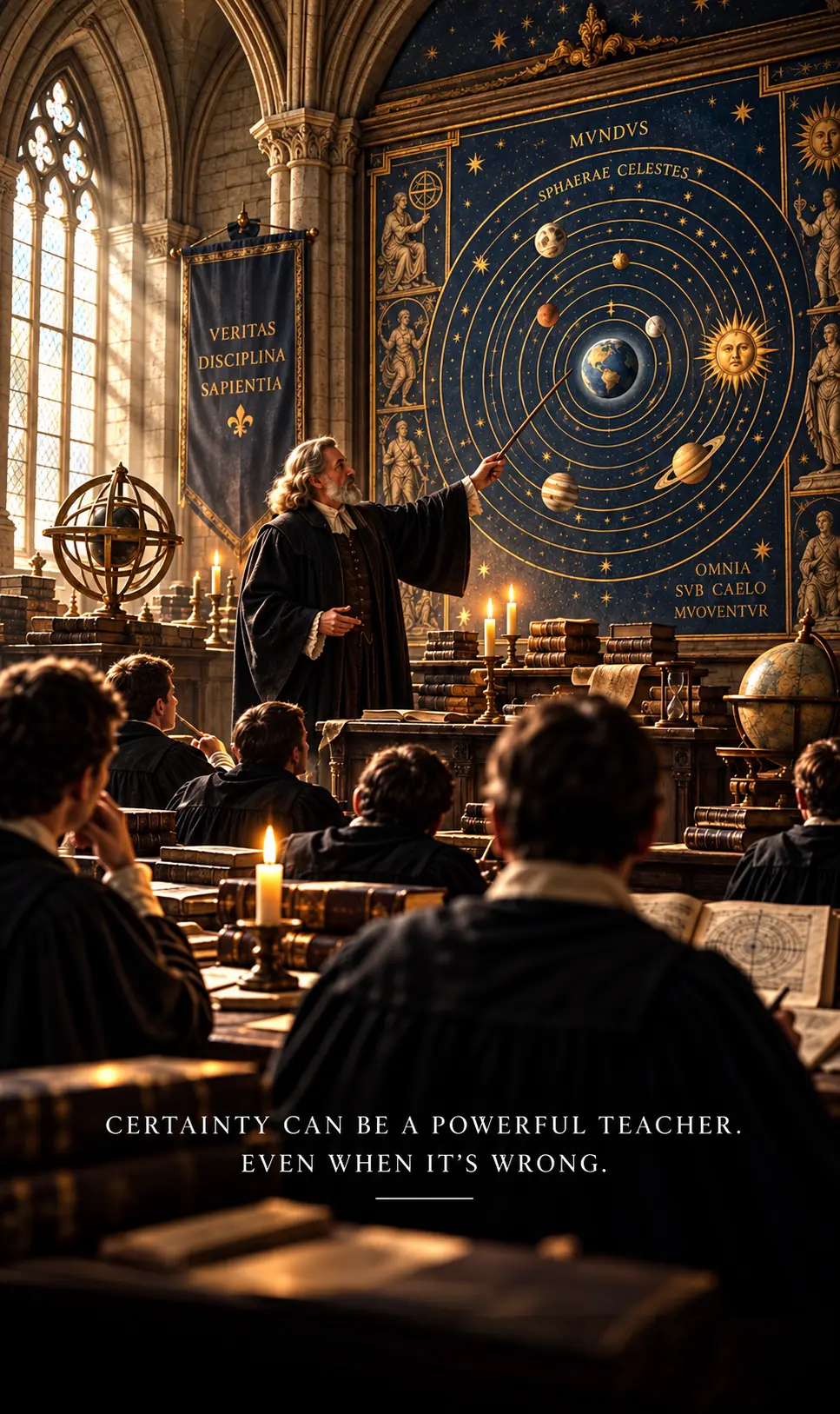
Imagine stepping into a European university centuries ago.
Stone walls rise around you.
Students gather beneath vaulted ceilings.
Books lie open across wooden desks.
At the front of the room, a scholar turns toward a diagram of the heavens.
The earth sits near its center.
Around it, the celestial bodies move through an intricate architecture of circles.
To the students watching him, this is not superstition.
It is knowledge.
It carries the weight of mathematics.
The authority of ancient philosophers.
The inheritance of generations.
Aristotle had placed a stationary earth at the center of the cosmos.
Ptolemy had constructed an extraordinarily sophisticated mathematical system for describing the movements observed in the heavens.
Universities studied it.
Astronomers calculated within it.
Generations learned to understand the sky through it.
And for centuries, the picture endured.
Not because everyone was foolish.
Because the picture worked well enough to become convincing.
Then something began to happen.
Observations accumulated.
Questions remained.
Old calculations required increasingly careful explanation.
And eventually, a Polish astronomer named Nicolaus Copernicus began reconsidering something almost everyone around him took for granted.
What if the earth moved?
The question was revolutionary.
But Copernicus had not changed the heavens.
He had changed the place from which humanity was looking at them.
The stars had not moved because he questioned the model.
The planets had not rearranged themselves.
Reality had been there the entire time.
Humanity's understanding of it was what had changed.
History has a peculiar way of hiding some of its greatest revolutions.
Not inside battles.
Not inside assassinations.
Not inside the rise and fall of empires.
Those are the revolutions we remember.
Some revolutions begin much more quietly.
Someone looks again.
A word changes.
A definition shifts.
One generation accepts the meaning.
The next generation never realizes there was an older one.
By the third generation, no one is examining the inheritance anymore.
They are simply repeating it.
That is how civilizations inherit certainty.
Not because everyone examined the evidence.
Because everyone inherited the conclusion.
Which raises an uncomfortable possibility.
What if some of the beliefs we hold with the greatest confidence today are not wrong because someone lied…
but because no one thought to ask the next question?
That question marks the beginning of every genuine investigation.
Not,
“What do I believe?”
But…
“How did I come to believe it?”
Those are not the same question.
One asks us to defend what we know.
The other asks us to reconstruct how we came to know it.
One protects certainty.
The other places certainty under oath.
And once certainty takes the witness stand…
it must answer to the evidence.
Excerpt from Chapter 1. Manuscript wording preserved.
Explore the book